
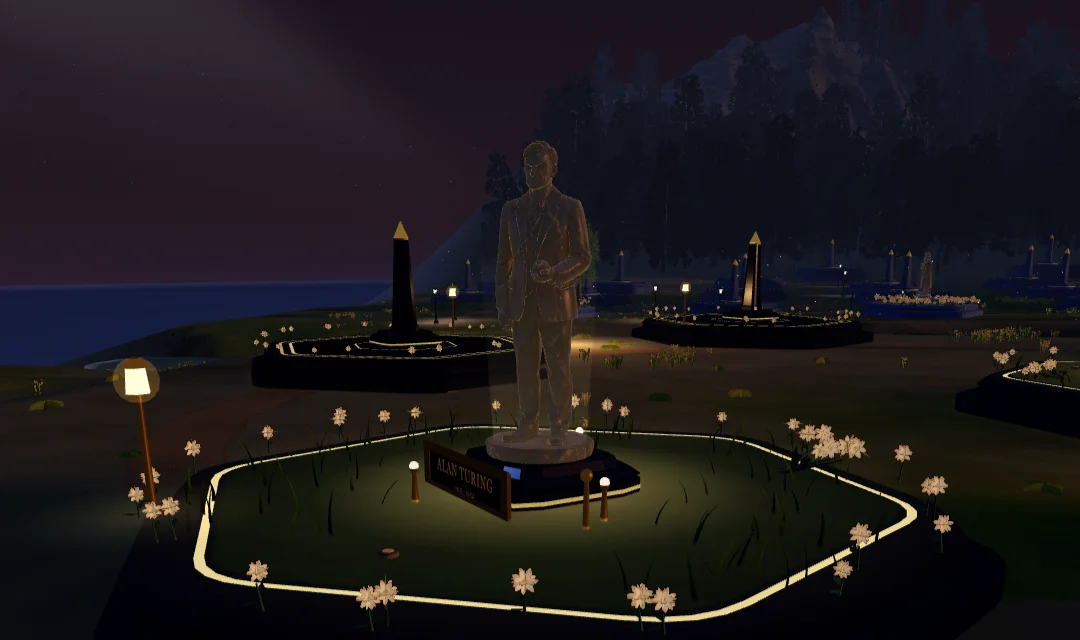
“We can only see a short distance ahead, but we can see plenty there that needs to be done.”
Computing Machinery and Intelligence, 1950Alan Turing was born in London in 1912 and thought in a register the century took decades to learn. At twenty three he imagined a simple machine of tape and symbols, and in imagining it he drew the boundary lines of everything computers would ever be.
At Bletchley Park his work helped read the war's most guarded letters and shortened the dark years by measures still being counted. Afterward he asked whether machines could think, and gave the question the form it still wears.
His country repaid him poorly and late. The apology came in 2009 and the pardon in 2013, and neither reached him. The mathematics needed no apology; it was already everywhere.
A tribute, kept by Here After All.
The work they left
On Computable Numbers, written at twenty three, invented the universal machine on paper a decade before any could be built: every computer since is that paper made metal. At Bletchley Park he broke the U-boat Enigma with the bombe machines, work counted among the war's decisive labors and kept secret for thirty years.
Computing Machinery and Intelligence, 1950, asked whether a machine can think and offered the imitation game, the test that still carries his name. His last work, on morphogenesis, asked how a chemical soup becomes the pattern of a leopard or the spiral of a sunflower, and was decades early there too.
The estate keeps ten tributes · Fyodor Dostoevsky · Franz Kafka · Nikola Tesla · Marie Curie · Arthur Schopenhauer · Emily Dickinson · Charles Darwin · Sigmund Freud · Vincent van Gogh