
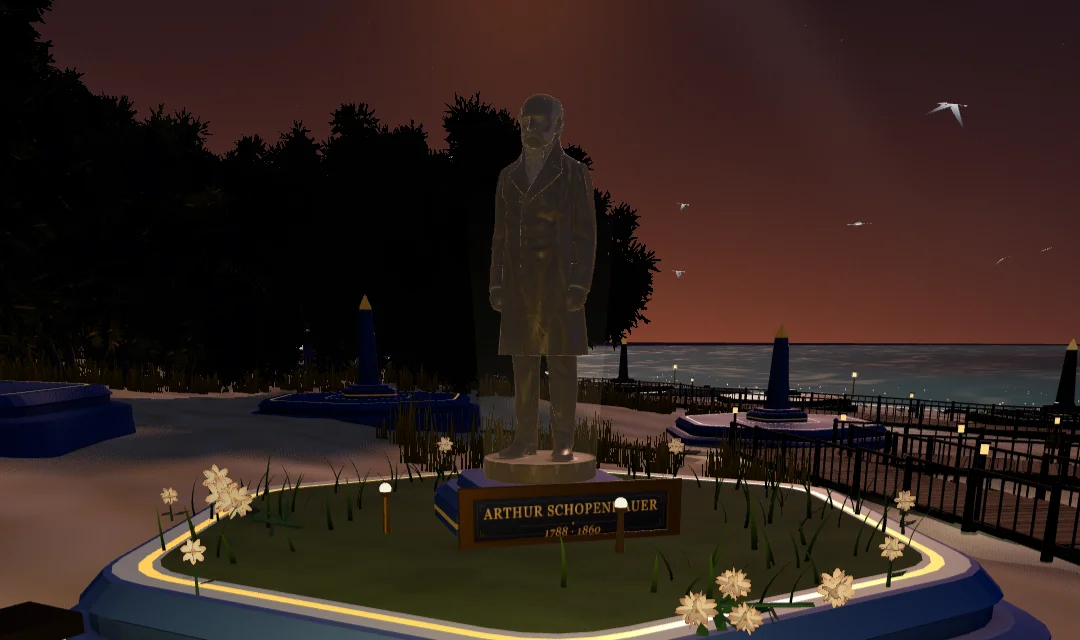
“Compassion is the basis of morality.”
On the Basis of Morality, 1840Arthur Schopenhauer was born in Danzig in 1788 into a merchant family, and came into enough money to think for himself, which he did with unusual independence.
His great work, The World as Will and Representation, held that a restless will drives all of nature, and that clear sight, art and compassion are the truest relief from its striving. For decades almost no one read him.
Recognition arrived only near the end, when the plain-spoken aphorisms of his later years found the wide audience his youth never had. He died in Frankfurt in 1860, admired at last.
A tribute, kept by Here After All.
The work they left
The World as Will and Representation, published at thirty and ignored for decades, holds his whole architecture: a restless will beneath all nature, and art, music above all, as the clearest window through it. On the Basis of Morality set compassion at the root of ethics a century before the word altruism was common coin.
The late Parerga and Paralipomena, with its Aphorisms on the Wisdom of Life, finally found the readers the early work deserved, and through them he reached Tolstoy, Wagner, Nietzsche, and Freud.
The estate keeps ten tributes · Fyodor Dostoevsky · Franz Kafka · Nikola Tesla · Alan Turing · Marie Curie · Emily Dickinson · Charles Darwin · Sigmund Freud · Vincent van Gogh